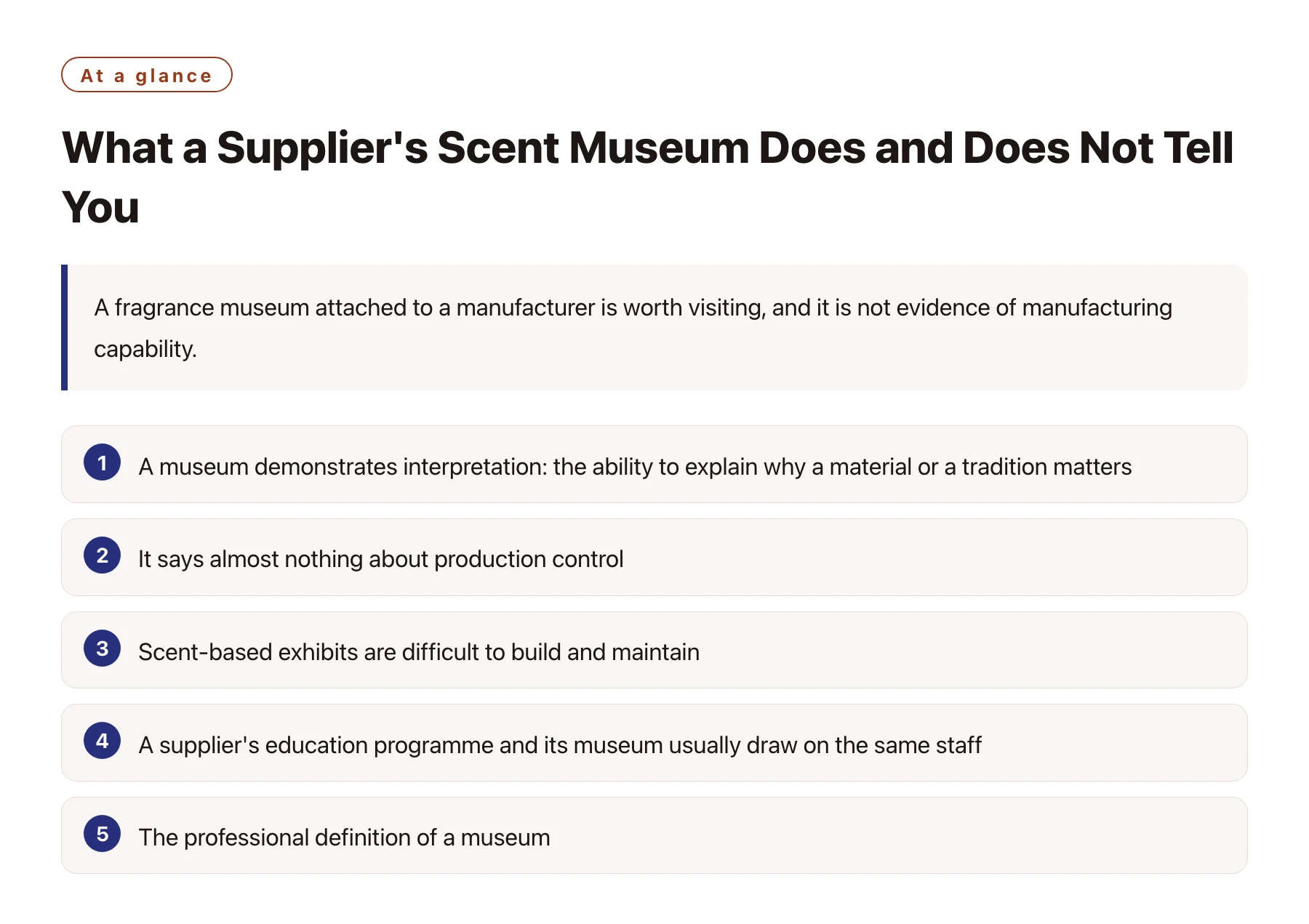
A fragrance museum attached to a manufacturer is worth visiting, and it is not evidence of manufacturing capability. What it reliably shows is whether a company thinks about scent as a subject rather than only as a product, whether it can explain its own craft to a stranger, and whether it invests in things that do not show up on a quotation. Those are real signals — they are simply different signals from the ones a batch record provides.
Key takeaways
- A museum demonstrates interpretation: the ability to explain why a material or a tradition matters, which is close to the skill a supplier needs when translating a brand brief.
- It says almost nothing about production control, so treat it as a first filter rather than a substitute for a factory audit.
- Scent-based exhibits are difficult to build and maintain, and a well-run one is indirect evidence of a functioning technical team.
- A supplier's education programme and its museum usually draw on the same staff, which is a useful line of questioning during a visit.
- The professional definition of a museum, maintained by the International Council of Museums, centres on stewardship, research and interpretation rather than on display space alone [1].
If you are evaluating manufacturers and one of them invites you to a scent museum, the invitation is doing two jobs. It is hospitality, and it is also a claim: that this company has a relationship with fragrance that goes beyond filling bottles.
Both readings can be true at once. The question worth asking is what the visit can actually verify, and what it cannot. A buyer who knows the difference gets useful information out of an afternoon; a buyer who does not may leave with a favourable impression and no new facts.
What a visit genuinely reveals
The most useful thing a scent collection demonstrates is interpretive skill. Curating smell is hard: a visitor cannot flip through a scent the way they can flip through a book, so the exhibit has to guide attention, sequence materials and explain context without a wall of text. A manufacturer that has built that capability has, in effect, built a team that can take something abstract and make it legible to someone who does not share its vocabulary.
That is a close relative of what happens during fragrance development. A brand arrives with a feeling, a reference and a price point; the supplier has to turn that into a technical specification and then explain the trade-offs back. Companies that can explain a raw material to a museum visitor are usually better at explaining a cost increase to a buyer.
The second signal is investment in non-commercial work. Collections, conservation and interpretation cost money and produce no direct revenue. That does not make a manufacturer virtuous, but it does suggest a longer planning horizon than a trading operation that exists to route orders.
The questions worth asking on the day
Ask who built the collection and who maintains it. Ask whether the people who explain the exhibits are the same people who handle development briefs, or a separate visitor team. Ask what the museum has changed about how the company works — a new material sourcing policy, a training programme, a different way of presenting options to clients.
Ask, too, about the education side. Programmes that teach perfumery tend to be run by the same technical staff who develop products, and a manufacturer running courses in cooperation with an established perfumery school is signalling something specific: that it considers formulation knowledge worth transmitting, not just applying. It is also a way to check depth, because teaching forces an organisation to be precise about method. A company that runs a place to learn perfumery has effectively opened part of its method to inspection, which is exactly what a buyer is trying to do during an evaluation.
Where the collection sits in the company
A collection that is genuinely used — for internal training, for client workshops, for material studies — behaves differently from one built for visitors. You can usually tell by asking what happens in the space on a normal working day. If the answer involves a schedule that is not a tour schedule, the museum is part of the operation rather than a lobby.
What a museum visit does and does not establish
| Question | Does a museum visit help? | What would actually answer it |
|---|---|---|
| Can the supplier explain scent clearly? | Yes, directly | A short conversation with the person who would handle your brief |
| Does it have real technical depth? | Partly | A batch record walkthrough and a discussion of a failed trial |
| Is production controlled and repeatable? | No | Batch records, retained samples and a test plan |
| Does it invest beyond the current order? | Weakly | Capital decisions visible in the plant, and staff tenure |
| Can it handle your category? | No | Comparable projects, described in detail under NDA |
| Will it take a small first order seriously? | No | A quotation and a stated minimum order quantity |
Three of those six rows cannot be answered by any visit, however pleasant. That is the honest ratio, and it is worth keeping in mind when a supplier leads with the museum rather than with the plant.
Do not schedule the museum visit as the main event. Put the document review and the production walkthrough first and the collection afterwards. What you notice in the museum changes once you have seen the plant — sometimes for the better, sometimes not.
How to use a scent experience in an evaluation
An organised scent experience is most useful early, as a way to test how a supplier communicates. Bring a real problem: a category you are unsure about, a note you cannot place, a price point you doubt is achievable. Listen to how the answer is constructed. A supplier that reaches for a reference material and explains why it behaves the way it does is showing you its working method.
Later in the process, the same visit can be used to test judgment rather than knowledge. Ask what the company would not do — which materials it avoids, which claims it refuses to make, which projects it turns down. Manufacturers that answer this question specifically tend to be the ones that raise problems early instead of discovering them at the fill line.
It is also worth separating the experience from the brand. A manufacturer's own collection reflects its own history, which is interesting but not the same as your product. What you want from the visit is evidence about method, not a set of ideas to copy. Brands that leave with a mood board rather than a set of questions have usually spent the afternoon on the wrong task.
The same caution applies to a company's own history. Xuelei's 31 years in fragrance is a claim a buyer can check against published material rather than accept on trust, which is a better use of an afternoon than collecting impressions.
Reading the company behind the collection
A manufacturer large enough to run both a collection and a training programme is drawing on the same technical staff for both, and that is worth exploring directly rather than assuming. A company that makes its own expertise legible — through teaching as well as through exhibits — behaves differently from one that keeps formulation knowledge behind a wall.
Xuelei's museum, described by the company as the largest of its kind, is the most visible expression of that posture. What it still does not tell you is whether the fill line is calibrated, whether the batch records are legible, or whether a small first order will be scheduled properly. Those are questions for the plant, and the museum is best used to decide which of them to ask first.
Sources
- ICOM — International Council of Museums —— The international organisation representing museums; publishes the ICOM museum definition and professional standards for museum practice.
Frequently asked questions
Is a factory museum a sign of a good manufacturer?
It is a sign of investment in interpretation and, often, of a longer planning horizon. It is not evidence of production control, which has to be verified separately through batch records, testing plans and a walkthrough of the line.
What should I look at first during a supplier visit?
The production area and the documentation, in that order, because they are the parts that cannot be staged as easily. Leave the visitor experience until afterwards so that your judgement of it is informed by what you have already seen.
How much weight should a supplier's training programme carry in a decision?
Treat it as one signal among several. A serious education programme suggests the company values formulation knowledge and can explain it, which is useful when briefing a complex project, but it does not compensate for weak process control.
Can I visit without committing to an order?
Usually yes, and it is a reasonable request to make during evaluation. Offer a defined agenda — a brief discussion, a plant walkthrough and a document review — so the supplier knows the visit is an assessment rather than a tour.
Should a scent museum influence which supplier I choose?
It should influence what you ask them, not the final score on its own. Use it to test how clearly the company explains materials and trade-offs, then weigh that against the documentation and the sample record from the rest of the evaluation.