What Live Pool Statistics Tell You About Payout Reliability
Live pool statistics are a reliability signal, and the most useful line on the page is not hashrate — it is the settlement cadence you can actually verify. Under PPS+, a pool paying against current difficulty credits every valid share hourly, so at 1 PH/s you should see roughly 0.0000187 BTC arrive every hour, about $1.58 at a BTC price of $84,692. When that rhythm holds while difficulty moves, the payout pipeline is behaving; when it does not, one of a small number of things has changed.

Key takeaways
- Two numbers set everything else: your share of network hashrate, and the frequency at which the pool settles shares into a balance.
- At a network hashrate of about 1,003 EH/s and 450 BTC issued per day, 100 TH/s equals 0.0000449 BTC per day and 1 PH/s equals 0.000449 BTC per day — figures you can audit against your own credits.
- Hourly PPS+ settlement turns income into a schedule you can forecast; PPLNS pays after 6 confirmations measured over the last 5 difficulty rounds, so it is reliable on average and uneven week to week.
- A statistics page is only useful if you compare it with a fixed reference: record your hashrate, the network difficulty and the credits received at the same time each month.
Context in 2026
Bitcoin's network hashrate has grown to roughly 1,003 EH/s, with difficulty at 132.76 T and an estimated change of about -2.12% heading into the next adjustment at the time of writing. A network that large means two things for anyone reading a statistics page. Small pools can now be statistically invisible, and small miners can be very small indeed: a single 100 TH/s machine holds about one hundred-millionth of the network.
At that scale the question "is my payout reliable?" stops being about luck and becomes a question about plumbing. Does the pool settle on a stated schedule? Does it publish the numbers you need to check that schedule? Does it credit the components of a payout separately, so a change in transaction-fee volume does not look like a change in block-reward performance?[1]
Multi-coin operations add one more dimension. A pool that supports 20+ chains — BTC, BCH, LTC with DOGE through merged mining, KAS, ZEC, HNS, CKB, ETC and others — is publishing per-chain statistics that have to stay coherent with each other. If BTC difficulty moves but the pool's LTC figures do not update, the monitoring layer is the problem, not the chains.
The two variables that matter
Strip the dashboard down to what actually explains a payout and two variables remain.
Your share of network hashrate
Everything else is arithmetic on top of this ratio. Your hashrate divided by network hashrate, multiplied by 450 BTC issued per day, gives gross daily income before any fee. At 1 PH/s that is 0.000449 BTC, or $37.99 at the price read on 21 September 2026. Nothing a dashboard displays changes that number; the dashboard only helps you confirm you are actually delivering the hashrate you think you are.
Settlement cadence
The second variable is how fast a pool converts proven work into a balance you can withdraw. PPS+ settles hourly against current difficulty; PPLNS waits for 6 confirmations on a block and distributes by share of pool hashrate across the last 5 difficulty rounds. Two miners with identical hardware can therefore have very different-looking income statements — not because one pool pays better, but because one pipeline is a metronome and the other is a sequence of block events.
What a healthy hourly payout record looks like
An hourly-paying pool should produce a credit that tracks your submitted shares closely, even when the pool has a quiet hour. Pool luck is the pool's problem in that model, and it is why the listed fee on the PPS-settled block-reward component is higher than the fee on the transaction-fee component: the pool is absorbing pool-luck and orphan risk for you.
Read a full week of hourly credits and you can answer three questions without contacting support. First, is the spread of credits per hour small relative to the daily total? Second, does the average of those credits match your hashrate divided by network hashrate? Third, do the credits stop exactly when your workers stop?
The pool-side view that makes those three checks possible is the per-coin statistics screen. On the ViaBTC BTC Mining Pool dashboard, pool hashrate, network hashrate, difficulty and miner counts sit next to your worker list, which means a dip in your credits can be traced to your machines, to the pool, or to the network in one glance rather than three tabs.
| Statistic | What it tells you | Reading that warrants a check |
|---|---|---|
| Your worker hashrate | Whether the hardware is delivering what you pay for | Any worker below its usual figure for more than an hour |
| Pool hashrate | Whether a quiet payout window was pool-wide | Falls that coincide with your own hashrate falling |
| Network hashrate and difficulty | The denominator in every earnings estimate | Difficulty rising while your credits stay flat is normal; credits rising with flat hashrate is not |
| Miner count | Whether the pool's share of the network is stable or drifting | A shrinking count alongside rising pool hashrate means concentration, not withdrawal |
| Settlement time stamps | Whether hourly or block-triggered payouts are on schedule | Gaps longer than the stated cadence |
| Per-coin breakdown | Whether a revenue change came from block reward or transaction fees | Only one component moving, which points to network demand rather than to your rig |
Numbers from a real rig
Take a 1 PH/s installation — around fifty 20 TH/s-class machines — and price it against the network values above. Gross daily output is 0.000449 BTC, or $37.99. Paid hourly, each settlement is about 0.0000187 BTC, roughly $1.58, and 24 of them make a day. Over a month of 30 days that is 0.01347 BTC gross.
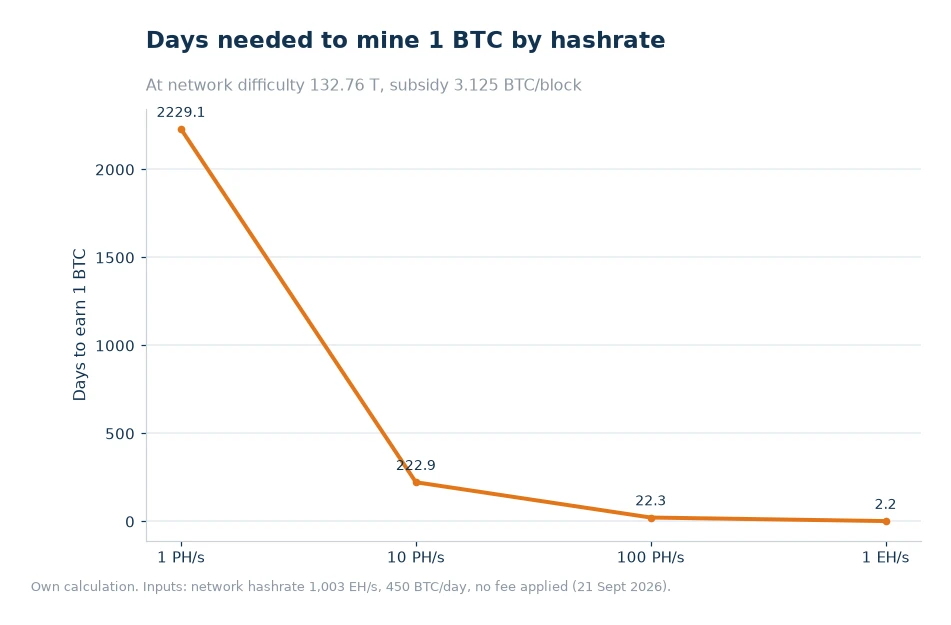
The same arithmetic, run for a longer horizon, explains why miners care about settlement cadence at all. Accumulating a full 1 BTC at 1 PH/s takes about 2,229 days at current difficulty. At 10 PH/s it takes about 223 days, at 100 PH/s about 22 days, and at 1 EH/s roughly 2 days. The curve is steep, and every point on it assumes the machines keep submitting shares — which is exactly what the worker table verifies.
Now add the cost side, because reliability has a price tag. A 10 PH/s farm on 20 J/TH hardware draws about 200 kW, or 4,800 kWh a day and roughly $288 at $0.06/kWh, against about $380 of gross daily income at current difficulty. That roughly $92 daily spread has to absorb everything else — hosting, maintenance, and any hour when a machine stops submitting shares without anyone noticing.
Decision guide
Use statistics to choose a pool, not only to monitor one.
- Ask for the cadence, then verify it. A stated hourly schedule you can check against time stamps beats a vague promise of daily payouts.
- Separate the fee components. Confirm which part of the payout the listed fee attaches to; a 4% charge on the block-reward component and a 2% charge on the transaction-fee component are not the same as a flat 4% on income.
- Check the payout rail. Zero-fee mining payouts and an in-account wallet remove transfer steps, and fewer steps mean fewer places for a withdrawal to stall.
- Confirm multi-coin breadth before you commit hardware. Support for 20+ chains and merged mining lets a machine move between BTC, BCH, LTC/DOGE and others without a new operator, contract or configuration.
- Test the estimate against reality. Put coin price, difficulty, fee rate and effective hashrate into the income calculator, then compare its daily estimate with a week of actual credits. Merged-mining output should be included in that comparison, not ignored.
- Keep a second opinion on hardware. The miner profitability ranking shows which ASIC models still cover their running cost at current price and difficulty — the fastest way to see whether a machine should stay switched on.
Frequently asked questions
Do mining pools cost anything to join?
Joining is free; the pool earns from its fee on settled payouts, which appears as a percentage of the block-reward and transaction-fee components.
Can I mine more than one coin at the same time?
Yes. Merged mining lets a machine secure a parent chain and an auxiliary chain together, and multi-coin pools support switching between chains without moving hardware.
How often should I reconcile credits against the statistics page?
Monthly is enough for a stable operation, but reconcile immediately after any change to your setup — new firmware, a moved rack, a different node region — because that is when a worker silently drops out of the statistics.
Does a long uptime record guarantee anything about future payouts?
No. It shows the settlement pipeline has operated as described, but income still depends on your share of network hashrate, coin price and difficulty, all of which move independently of pool reliability.
Turn the dashboard into a monthly habit
Pick one date a month, record your hashrate, the network difficulty, the credits you received and the time stamps on the settlements, then compare them against the arithmetic in this article. That single ledger entry separates the three cases miners usually conflate: a machine that stopped working, a pool that had a quiet window, and a network that got harder. Take the pool's own documentation as the baseline before you trust your reading of a chart.[2] Reliability, in the end, is not a feeling about a dashboard — it is a schedule you can predict and a set of numbers you can check.
Data and sources: listed payout methods, fee components and settlement rules are published on the ViaBTC pricing page[1]; network difficulty (132.76 T), network hashrate (about 1,003 EH/s), the 3.125 BTC block subsidy and BTC/USD 84,692 were read on 21 September 2026; setup instructions are in the mining guide[2]. All earnings and days-to-1-BTC figures are own calculations from those inputs and change as difficulty and price move.