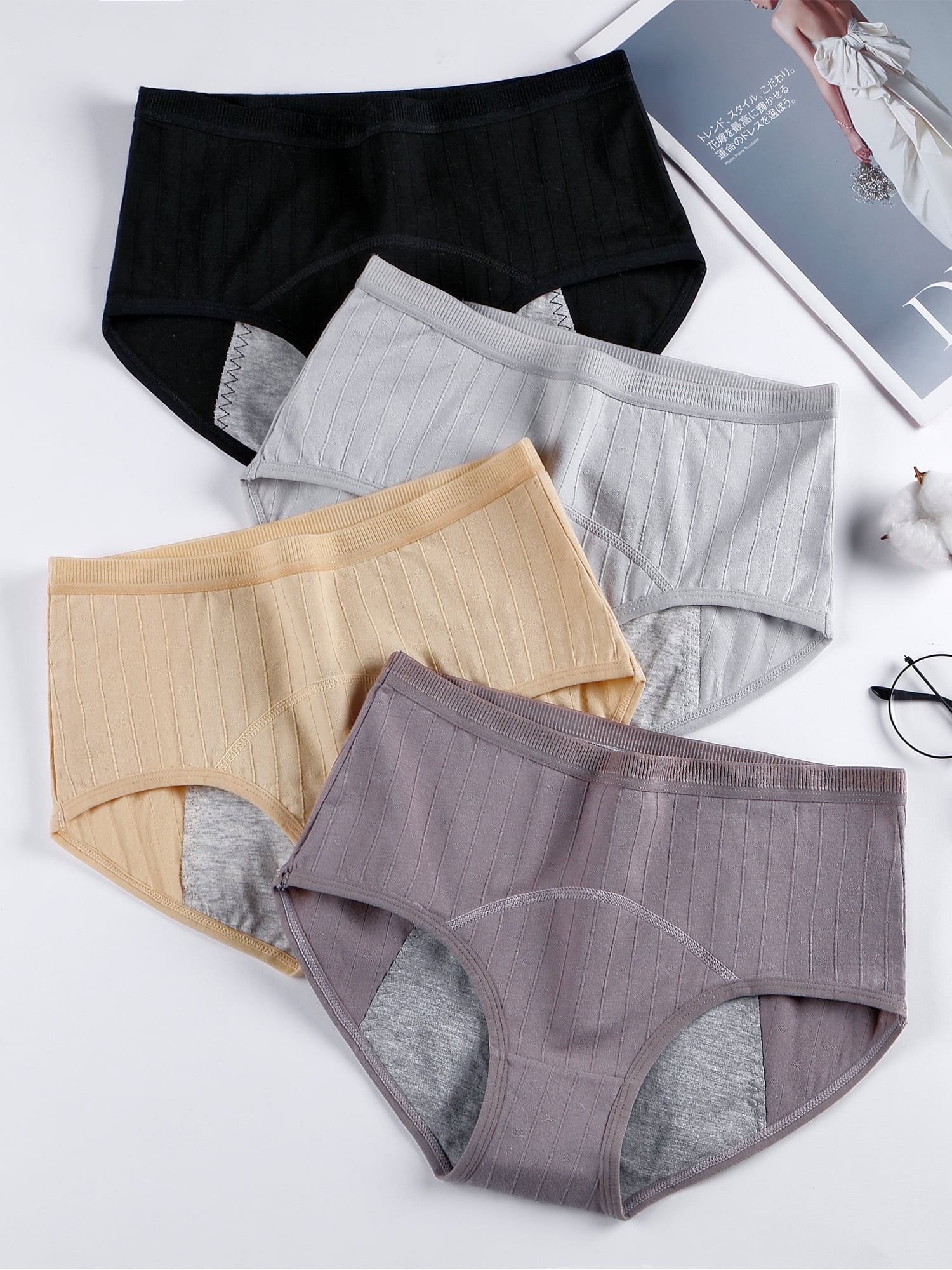
High-quality private label period underwear stands out through measurable fluid handling, stable fit, wash durability, material control, and repeatable factory production. A good product should move liquid away from the skin, store it without heavy rewet, resist leakage around the gusset, and keep its dimensions after repeated laundering. AATCC maintains separate methods for textile absorbency, moisture management, drying, laundering, and water resistance, showing why one “mL capacity” figure cannot describe total performance. In the US, textile labels must also identify fiber percentages and manufacturing origin, while care instructions need a reasonable technical basis before sale.
For brands developing private label period underwear, product quality starts inside the gusset rather than with waistband printing or package design. Most reusable constructions use three or four functional zones: a skin-facing transfer layer, an absorbent layer, a liquid-resistant membrane, and the outer underwear fabric. Each layer performs a different job, so adding thickness does not automatically improve protection. A 4-layer gusset can still perform worse than a thinner 3-layer construction when liquid spreads slowly or collects in one small area.
That construction question leads to the first measurement buyers should request: absorption behavior under controlled conditions. AATCC TM79-2025 applies to yarns, fabrics, and garments of woven, knitted, or nonwoven construction, while AATCC also lists TM195 for liquid moisture management, TM197 for vertical wicking, TM198 for horizontal wicking, and TM199–TM201 for drying performance. Capacity, intake speed, spreading, rewet, and drying should be treated as separate measurements.
A laboratory result of “30 mL absorbency” says little about how fast those 30 mL enter the textile, whether pressure pushes liquid back toward the skin, or whether fluid reaches the edge of the gusset before being stored.
Once liquid reaches the absorbent zone, distribution becomes as important as storage volume. A narrow high-capacity insert may saturate locally during sitting or sleeping, while a longer insert can spread fluid over more surface area. For overnight styles, extending coverage toward the rear can be more useful than adding another thick layer. Buyers should therefore specify gusset length and width in millimeters and set dimensional tolerances rather than describing a sample only as “heavy flow.”
| Development item | What to record | Why it matters |
|---|---|---|
| Gusset length | mm by size | Controls front/rear coverage |
| Gusset width | mm at defined points | Affects side protection |
| Finished garment weight | grams | Flags material variation |
| Fabric composition | % by weight | Supports labeling and repeat orders |
| Dimensional change | % after laundering | Shows fit stability |
| Absorption result | method + measured value | Makes claims comparable |
Fit comes next because absorbent material cannot work properly when the garment shifts away from the body. Waist circumference, hip width, front rise, back rise, leg opening, side length, and gusset position should be graded independently. Increasing every measurement by a fixed 5% from one size to the next is rarely sufficient for underwear because body proportions do not increase at one constant rate. Factories should check several sizes from a size set rather than approving only a medium sample.
Fit control also depends on stretch recovery. A fabric may contain only 4% elastane yet still use that fiber for a defined functional purpose; US FTC guidance specifically recognizes that fibers below the usual 5% disclosure threshold may be named when they have a clear functional role, using 4% spandex for elasticity as an example. The same guidance notes a general 3% manufacturing tolerance for stated fiber content under defined circumstances, although intentional fiber additions cannot simply be covered by that tolerance.
A supplier therefore needs more than the nominal fiber recipe. Fabric weight, width, stretch direction, extension, recovery, shrinkage, surface finish, dye lot, and roll identity should be tied to the approved bill of materials. A change from one nylon-elastane fabric to another with the same 80/20 composition can still alter compression, drying, hand feel, and finished measurements because fiber percentages do not describe yarn structure, knit density, or finishing.
Material control becomes more important after laundering. Reusable underwear is repeatedly exposed to water, detergent, agitation, and drying, so pre-wash approval alone gives an incomplete view. AATCC currently lists TM61 for accelerated laundering colorfastness, TM124 for appearance after home laundering, TM135 for dimensional change, and TM179 for skew change. Brands can use recognized methods or documented internal protocols, but the wash condition and pass/fail limits should be fixed before production.
A practical development sheet might require measurement before washing and again after 5, 10, or 20 defined cycles. Those cycle counts are commercial specifications, not universal industry limits. The useful part is consistency: if a waistband measures 680 mm before washing, the same measurement point, conditioning procedure, and allowable percentage change should be used on every comparison sample.
“Wash tested” is too vague for supplier approval. “Tested for 20 cycles under the stated care procedure, with dimensional change recorded at five garment points” gives a factory and buyer something they can reproduce.
Wash testing naturally connects to care labels. Under the FTC Care Labeling Rule, US manufacturers and importers of covered textile apparel must provide regular care instructions and possess a reasonable basis for them before sale. The rule has applied in its amended form since September 1, 2000, and the label is expected to remain legible during the useful life of the product. A claim such as “machine wash, tumble dry” therefore needs to match the materials actually used in the gusset, elastic, membrane, and shell.
Chemical specifications deserve the same level of documentation. Period underwear has prolonged skin contact, and some constructions use membranes, adhesives, dyes, prints, or surface treatments. OEKO-TEX revised PFAS-related STANDARD 100 limits from January 1, 2024, including a total fluorine limit of 100 mg/kg across product classes, with specified exceptions. A brand using such certification should verify the certificate scope, product class, validity, and whether the exact materials in bulk production are covered.
Supplier discussions should also separate untreated textile performance from added antimicrobial or odor-control finishes. If a finish is proposed, request its chemical identity, application level, wash durability, supporting test method, and permitted market claims. AATCC maintains TM100 and TM147 for assessing antibacterial activity in textile materials, while moisture performance has its own separate group of methods. One test result should not be presented as proof of an unrelated function.
Label accuracy then becomes part of manufacturing quality rather than an afterthought. In the United States, the Textile Fiber Rule requires covered products to disclose generic fiber names, percentages by weight, the manufacturer or marketer identity, and the country where the product was processed or manufactured. Fibers representing 5% or more normally appear by generic name, while defined exceptions apply to smaller functional components.
For sales in the European Union, Regulation (EU) No 1007/2011 requires multi-fiber textile products to show fiber names and percentages by weight in descending order. The terms “100%,” “pure,” and “all” are reserved for products meeting the regulation’s single-fiber requirements, and consumer-facing fiber information must be legible and visible, including before an online purchase. A private-label specification should therefore map each fabric panel to its exact composition rather than relying on a general statement such as “cotton blend.”
Those regulatory details feed directly into production control. A pre-production sample should match the approved material codes, measurements, gusset construction, label text, stitching, color, packaging, and care information. During bulk production, incoming fabric checks, in-line sewing inspection, finished measurements, and shipment sampling reduce the chance that an approved sample and the delivered order become two different products.
-
Record fabric roll and dye-lot references.
-
Measure defined garment points in millimeters.
-
Check gusset alignment against a physical tolerance.
-
Compare finished weight in grams with the approved reference.
-
Inspect stitching, elastic attachment, membrane bonding, and label placement.
-
Keep at least one approved production reference from the 2026 order or relevant production season.
Sampling plans also need enough coverage to reveal repeat problems. Checking only 3 pieces from a 5,000-piece order gives little information about size distribution, sewing consistency, or recurring defects. Buyers commonly build inspection quantities around recognized acceptance-sampling systems, while higher-risk construction points can receive stricter internal checks. The supplier and brand should agree on defect classes, sampling level, and acceptance criteria before sewing starts rather than arguing over visual standards after packing.
The same discipline applies to absorbency claims. “Equivalent to four tampons” or “12-hour protection” combines textile performance with assumptions about menstrual flow, user anatomy, fit, movement, and replacement habits. A controlled liquid-capacity result can support one part of a product description, but it cannot reproduce every wear situation. Brands should state the test method and measured condition behind numerical protection claims whenever those numbers are used commercially.
Private-label buyers can learn a great deal from the factory’s answers before ordering. Ask for the exact number of gusset layers, composition of each textile layer, test methods, laundering protocol, measurement tolerance, available size-set samples, material traceability, and inspection records. Ask whether bulk fabric comes from the same approved source and whether substitutions require written approval. A factory that can provide a 20-cycle wash record, a controlled absorbency result, and measured size tolerances provides more useful information than one that offers only a “premium quality” description.
Price should be read beside those controls. Removing one inspection step, using a lower-cost membrane, accepting wider measurement tolerances, or changing fabric weight by 10% can lower manufacturing cost while keeping a product visually similar in a product photograph. Buyers comparing quotations should therefore normalize material specifications, testing, packaging, size range, inspection scope, and order quantity before deciding whether a lower unit price represents the same product.
A strong commercial specification can fit on a few structured pages: garment measurements, tolerances, bill of materials, absorbent construction, test requirements, color standard, labels, packaging, and approved sample references. When the specification contains percentages, millimeters, grams, test methods, and defined wash cycles, factory performance can be compared from one order to the next instead of being judged by subjective descriptions.